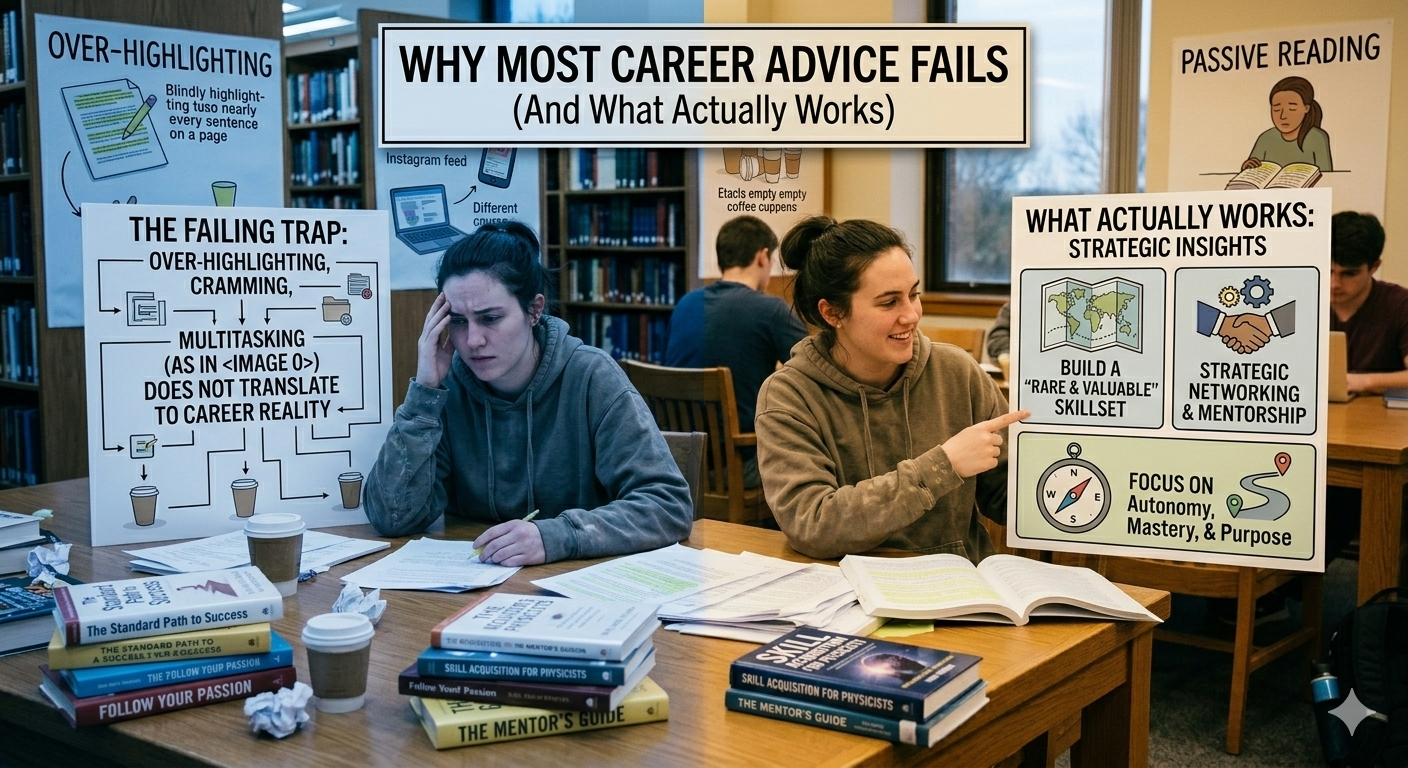
The Problem With Generic Advice
Career advice is everywhere: social media, blogs, videos, mentors — everyone is sharing what you should do to succeed. Initially helpful, it quickly becomes confusing.
One person says “follow your passion.” Another says “focus on high-paying skills.” Someone else tells you to “learn coding,” while others suggest “build a personal brand.”
The problem is not that this advice is wrong, but that it is too generic. It does not consider your background, skill level, interests, or goals.
What works for one person may not work for you. Following random advice without context often leads to wasted time and frustration.
Information Overload Creates Inaction
Consuming too much advice leads to overthinking and constant comparison, preventing action.
You learn endlessly but never start doing. Watching more videos, reading more articles, preparing more — execution never begins.
This is called analysis paralysis. You are busy but not productive. Real progress happens when you act, not when you collect information.
There Is No Universal Roadmap
Many platforms provide “perfect career roadmaps”: steps like learning skills, completing courses, and building projects.
While useful, these roadmaps are generalized and assume everyone starts at the same level and pace.
Everyone is different. Strengths, weaknesses, and learning speed are unique. Fixed roadmaps can feel too easy, too hard, or irrelevant.
A roadmap should guide you, not control you.
Learning Without Execution Is Useless
Focusing on learning without doing is a common mistake.
Completing courses, watching tutorials, and taking notes does not build real skill. Execution is where learning becomes tangible.
Without applying concepts, knowledge remains theoretical. If you cannot build something with what you learned, you have not truly learned it.
The Missing Element: Accountability
Career advice often ignores how to stay consistent. Starting is easy; continuing is hard.
Without accountability, it is easy to skip days, delay tasks, and lose focus. Inconsistency is the biggest reason people fail.
Accountability creates discipline. Tracking work and measuring progress ensures you stay consistent.
Progress Needs to Be Measurable
Common advice rarely defines measurable progress.
Relying on vague indicators like 'I feel I am improving' is unreliable.
Track tasks completed, projects built, time invested, and skill improvement. Visible progress keeps you motivated and focused.
Measurement turns effort into results.
Proof of Work Matters More Than Claims
Resumes list skills but do not prove performance.
In a competitive environment, claims are not enough. Projects, assignments, and tangible outputs demonstrate ability.
Consistently producing work creates a portfolio that builds trust and opens opportunities. Advice ignoring proof of work is incomplete.
Personalization Is the Key
The most effective career path is personalized.
Understand your current level, identify gaps, and focus on high-impact areas.
Beginners should not follow plans for experienced individuals. Focus on relevant skills for your role.
Personalization avoids wasted effort and makes the journey efficient and realistic.
What Actually Works
Instead of random advice, follow a simple, practical approach:
1. Choose one clear goal
2. Break it into smaller tasks
3. Work on tasks daily
4. Track progress
5. Build real projects
6. Review performance regularly
This shifts focus from consuming information to creating results. Done consistently, it is extremely powerful.
Final Thought
Most career advice fails because it is generic, passive, and execution-agnostic.
Clarity, consistency, and measurable action are what actually work.
Stop chasing random advice. Focus on doing real work every day. The difference is not in knowing more, but in doing more, consistently.